

The VA won't show you the math. We will.
Here is how to use this, and why I built it. Every calculator and eligibility screener on this site is 100% free, with no sign-up, no email wall, and no catch, because I got tired of watching veterans leave money on the table simply because nobody ever showed them the math. Pick the benefit you are chasing, answer a few plain questions, and you will see, in real dollars, exactly what you and your family have earned, whether that is monthly disability compensation, SMC, DIC, pension, education, or a VA home loan. Learn the system here first, run your own numbers, and then decide for yourself whether you want an accredited claims agent to confirm those numbers with a free review of your records. I created this for my veteran community so you walk in knowing exactly what you should be getting, not what the VA hopes you will settle for.
Your benefits, explained in plain English
It's me, Albert L. Thombs Jr., VA Accredited Claims Agent #45147. In a couple of minutes I walk you through how this site works and what these free calculators actually show you. Here is what I want you to take away before you watch anything else: the VA is adversarial from the day you separate, and nobody hands you a checklist on the way out. Watch this, then run your own numbers. When you hit the wall you cannot see through, a free review of your records is how we find what the VA left on the table.
0%
of U.S. veterans collect zero VA disability compensation
0%+
of eligible veterans never file a claim at all
0%
of rated veterans are under-compensated right now
0+
new PACT Act presumptive conditions since 2022
How it works
Here is the honest path I would put any veteran on, and it is only four steps: learn what you actually earned, run your own numbers, ask me anything along the way, and when the claim outgrows a calculator, bring in an accredited claims agent. My advice, do not skip step one. Most veterans lose money because they never understood what was on the table in the first place.
 1
1Learn what you earned
Nine benefit categories explained in plain English, from disability compensation to education and home loans. No jargon, no sign-up, just the facts.
 2
2Run the numbers yourself
Free calculators built on the current VA rate tables. See your estimated monthly pay, GI Bill housing allowance, back pay, and more in real dollars.
 3
3Ask Albert anything
Got a question at 2 a.m.? Albert is an AI assistant built on VA regulations and over a decade of claims experience. Free, 24/7, no appointment needed.
 4
4Bring in an accredited agent
Denied or under-rated? A VA-accredited claims agent can pull your file, find what the VA missed, and fight the claim for you. The first review is free.
Run the numbers yourself
Every one of these is built on the current VA rate tables, with no account, no email wall, no catch. What I want you looking for is the gap between what you are getting now and what your record could support. Your exact figures depend on the evidence in your file, but these show you the ballpark before you ever talk to a soul. Get your numbers first, then decide your next move, because knowledge is leverage.







Ran the numbers? Now make them count.
The calculators show what you could be owed. We make sure the VA actually pays it. Ask us anything for free, or register when you are ready to have us fight your claim.
I read every one of these myself. If you qualify, you’ll hear from me within 48 hours. Or call 702-992-4883.
My advice to you
Not a brochure. A financial planning toolkit.
Let me be clear about something. The benefits you earned are not a handout. They are part of what you and your family were promised for your service, and you have every right to understand them, plan around them, and fight for every dollar. I say that as a 100% disabled veteran who wasted years not knowing any of this.
These free tools show you, in real dollars, the support available to you and your family, including benefits most veterans never realize they qualify for. Here is what I want you to do: run the numbers, understand your position, then decide for yourself whether you want an accredited claims agent to confirm them with a free review of your records. No pressure, ever.

See it in real dollars
Every tool runs on the current VA rate tables. Your monthly, annual, and lifetime figures reflect what you could actually receive, not some feel-good guess.

Screen your eligibility
Check the benefits you may qualify for based on your service, exposure, and situation. Most veterans have benefits no one ever told them about.

Plan for your whole family
Disability money is family money. Many benefits reach spouses, children, and survivors. See the full picture so your family can plan together.
New to VA benefits? Start here
Three short official videos straight from the U.S. Department of Veterans Affairs: how compensation works, how yourcombined rating is calculated, and what the PACT Act changed. My advice, watch these first so the VA's own words are in your head, then run your numbers with the free tools above. The more you understand going in, the harder you are to short.
How VA disability compensation works
The VA's own overview of what disability compensation is and how to apply. Watch this first, then run the calculators with your numbers.
How your combined rating is calculated
VA math is not normal math. This video explains why ratings combine the way they do, and our Combined Rating calculator does the same math for you instantly.
Your PACT Act toxic-exposure benefits
Burn pits, Agent Orange, radiation. The PACT Act opened doors the VA kept shut for decades. Watch, then run the free PACT Act screener to check your conditions.

Denied or under-rated? This is what we do.
We take appeals and rating fights, the cases the VA got wrong. Ask us anything for free, or register and an accredited agent starts building your case.
I read every one of these myself. If you qualify, you’ll hear from me within 48 hours. Or call 702-992-4883.
How the VA combined ratings formula actually works
Here is one that surprises almost every veteran I talk to: the VA does not add your ratings together. It uses a “whole person” method under 38 CFR §4.25 — and it is the reason so many veterans are rated lower than they expected. Let me walk you through the math, all the way through.
Worked example
A veteran rated 70%, 50%, and 10%
Simple math says 70 + 50 + 10 = 130%. The VA does not work that way. Here is what actually happens.
- 1
Start at 100% whole
0% combinedBefore any rating is applied, the VA treats you as a whole person — 100% healthy, 0% disabled.
- 2
Apply the highest rating first: 70%
70% combinedThe VA always starts with your largest rating. 70% of the whole person is taken. That leaves 30% of you “whole” for the next rating to work on.
- 3
Apply the next rating: 50% — but only to what is left
85% combinedThe 50% rating is not added to 70%. It is applied to the 30% that remains. 50% of 30 is 15, so 15 points are added, not 50.
- 4
Apply the last rating: 10% — to the 15% still remaining
86.5% combined10% of the remaining 15 is 1.5, so only 1.5 points are added. This is why small ratings barely move the needle once you are already highly rated.
- 5
Round to the nearest 10%
90% final ratingUnder 38 CFR §4.25 the VA rounds the combined figure to the nearest 10 percent. 86.5 rounds up to 90.
The result: three ratings that look like 130% on paper pay at the 90% rate — not 100%. That single gap is worth well over $1,000 a month in tax-free compensation.
Bilateral factor explained
When both arms or both legs are rated, you get extra credit
Under 38 CFR §4.26, if you have ratable disabilities affecting both arms, both legs, or paired skeletal muscles, the VA first combines those paired ratings, then adds an extra 10 percent of that combined figure as the bilateral factor. Only after that is the result folded into your overall combined rating.
It is a small bump, but it is applied before rounding — which means it can be the difference between rounding down to 80% and rounding up to 90%. It is also one of the most commonly missed calculations in a rating decision.
Three rules worth memorizing
- Order matters. Ratings are always applied highest to lowest. The same set of ratings in a different order still produces the same answer, but the highest one always does the heavy lifting.
- Small ratings shrink. Once you are at 70% or above, a new 10% condition adds only a point or two. That is normal math, not a VA error.
- You can be paid at 100% without a 100% rating. If your service-connected conditions keep you from holding gainful work, TDIU under 38 CFR §4.16 pays at the full 100% rate.
PACT Act presumptive conditions, at a glance
Let me explain what “presumptive” really means for you: the VA accepts that your condition came from your service — you do not have to prove the link with a nexus letter. If you meet the service test below and you have the diagnosis, the connection is presumed. That is the easiest path to service connection there is, and I do not want you to miss it.

Burn pits & airborne hazards
PACT Act, Public Law 117-168 (August 10, 2022)
Where & when you served
- On or after August 2, 1990 — Bahrain, Iraq, Kuwait, Oman, Qatar, Saudi Arabia, Somalia, the United Arab Emirates, or the airspace above them.
- On or after September 11, 2001 — Afghanistan, Djibouti, Egypt, Jordan, Lebanon, Syria, Yemen, Uzbekistan, or the airspace above them.
Conditions covered
- Cancers: head, neck, respiratory, gastrointestinal, and reproductive cancers of any type, plus lymphoma, kidney cancer, brain cancer, melanoma, and pancreatic cancer.
- Respiratory: asthma diagnosed after service, chronic bronchitis, COPD, constrictive bronchiolitis, emphysema, granulomatous disease, interstitial lung disease, pleuritis, pulmonary fibrosis, sarcoidosis, chronic rhinitis, and chronic sinusitis.

Agent Orange — newly covered locations
PACT Act, Public Law 117-168 (August 10, 2022)
Where & when you served
- Thailand, at any U.S. or Royal Thai base — January 9, 1962 through June 30, 1976.
- Laos — December 1, 1965 through September 30, 1969.
- Cambodia, at Mimot or Krek in Kampong Cham Province — April 16 through April 30, 1969.
- Guam, American Samoa, and their territorial waters — January 9, 1962 through July 31, 1980.
- Johnston Atoll, or aboard a ship that called there — January 1, 1972 through September 30, 1977.
Conditions covered
- All existing Agent Orange presumptives now extend to these locations — including ischemic heart disease, Type 2 diabetes, Parkinson’s disease, and several cancers.
- The PACT Act also added two new Agent Orange presumptives for all covered veterans: high blood pressure (hypertension) and monoclonal gammopathy of undetermined significance (MGUS).

Radiation exposure — newly covered cleanup sites
PACT Act, Public Law 117-168 (August 10, 2022)
Where & when you served
- Cleanup of Enewetak Atoll — January 1, 1977 through December 31, 1980.
- Cleanup of the 1966 Palomares, Spain nuclear incident — January 17, 1966 through March 31, 1967.
- Response to the 1968 fire aboard an aircraft near Thule Air Force Base, Greenland — January 21 through September 25, 1968.
Conditions covered
- Service at these sites now counts as a radiation-risk activity, which opens the existing list of radiation presumptive cancers — including leukemia, and cancers of the thyroid, breast, lung, stomach, colon, bone, liver, and more.

Camp Lejeune contaminated water
Camp Lejeune Justice Act of 2022, enacted within the PACT Act
Where & when you served
- Lived or served at Camp Lejeune or MCAS New River, North Carolina, for at least 30 cumulative days — August 1, 1953 through December 31, 1987.
- Covers active duty, National Guard, and Reserve members — and family members who lived there.
Conditions covered
- Adult leukemia, aplastic anemia and other myelodysplastic syndromes, bladder cancer, kidney cancer, liver cancer, multiple myeloma, non-Hodgkin’s lymphoma, and Parkinson’s disease.
Two things veterans get wrong here. First, a presumptive condition still has to be diagnosed and documented — the presumption covers the cause, not the diagnosis. Second, a previous denial does not close the door: if your condition became presumptive after you were denied, you can file again, and the effective date can reach back. This list is a summary for planning, not the complete regulation.
What the VA won’t tell you: the rating errors that cost veterans thousands
Let me be straight with you: these are the exact mistakes I look for the moment I open a claims file as your accredited claims agent, and I find at least one of them far more often than I should. The VA processes millions of claims, a rushed rater or an inadequate C&P exam can shave points off a rating that should have been higher, and nobody at the VA is going to circle back and fix it for you. None of these errors are rare, none of them are your fault, and every single one of them is money a veteran earned and never received. Read through them — if even one sounds like your decision letter, that is exactly the kind of thing a free review of your records is built to catch.

The bilateral factor was missed
When you have ratable disabilities in both arms or both legs, 38 CFR §4.26 adds an extra percentage before your combined rating is set. It is easy to overlook, and skipping it can quietly drop your final rating a full step.

Secondary conditions were never claimed
Conditions caused by an existing service-connected disability — depression from chronic pain, sleep apnea secondary to a breathing condition — are ratable too. If they were never filed, they were never counted.

Your effective date was set too late
Filing an Intent to File under 38 CFR §3.400 locks in your effective date for up to a year. Miss it, and months of back pay you were owed simply disappear from the award.

TDIU was available but never mentioned
If service-connected conditions keep you from steady work, 38 CFR §4.16 can pay you at the 100% rate even below a 100% combined rating. Many decisions never raise it, even when the file clearly supports it.

SMC entitlement was overlooked
Special Monthly Compensation under 38 CFR §3.350 is extra tax-free pay for serious losses or the need for daily aid and attendance. It is supposed to be automatic, but it is one of the most commonly missed awards.

A mental-health rating was set too low
Mental-health conditions are rated under 38 CFR §4.130 on how much they impair work and daily life — not the diagnosis. A file rated at 50% when the evidence supports 70% is one of the costliest and most common errors.
Know what you earned
VA benefit categories, explained
Plain-English summaries of every major benefit: what each one is worth, who qualifies, and which calculator to run. Here is what I want you to notice as you read, service connection is the key that unlocks all of it. Nail that first and the rest follows, for you and for your family.









2027 VA benefit rates, at a glance
Let me tell you exactly what is coming, because nobody at the U.S. Department of Veterans Affairs is going to sit you down and spell it out. Every year your VA compensation gets a Cost-of-Living Adjustment (COLA), and that increase is not decided by a committee that gets to vote on whether you deserve it. Congress locked it into law years ago: your VA disability pay rises by the exact same percentage as the Social Security COLA, and that percentage is set by the government’s own inflation gauge, the Consumer Price Index for Urban Wage Earners and Clerical Workers (CPI-W), measured over July, August, and September of 2026. That is the whole machine. No politician gets to skip your raise in a good year, and no politician can hand you extra in a bad one, it tracks the cost of bread, gas, and rent, period.
Here is what you have to look forward to. As of right now, the analysts who track the CPI-W month by month are projecting the 2027 COLA at roughly 3.8% to 3.9%, with the full range of forecasts running from about 2.8% up to 4.7%. Treat those as estimates, not promises, because the number is not final until the Social Security Administration announces it in mid-October 2026. Once it is announced, the higher rates take effect December 1, 2026, and they land in the payment you receive in January 2027. It applies straight across the board, every rating from 10% through 100%, plus TDIU, Special Monthly Compensation (SMC), Dependency and Indemnity Compensation (DIC), and VA pension. And you do not fill out a single form to get it, the VA raises your check automatically.
Now read this next part twice, because it is the whole point of this site. The COLA only raises the rating you already have. The table below shows the current confirmed rates, the baseline the 2027 COLA gets applied on top of, alongside the governing regulation behind each figure so you can verify every dollar yourself. Look at the jump from 90% ($2,362.30 / mo) to 100% ($3,938.58 / mo), that is over $1,500 a month, and a 3.8% COLA multiplies a bigger number for you at 100% than it ever will at 90%. That is exactly why fighting for the rating you EARNED matters more than waiting on the raise. Get the rating right first, then let the COLA compound it every year for the rest of your life.
| Benefit | Estimated rate | Governing regulation |
|---|---|---|
| 100% + spouse & one child | $4,318.99 / mo | 38 CFR Part 4 |
| Disability Compensation — 100% (single) | $3,938.58 / mo | 38 CFR Part 4 |
| TDIU (paid at the 100% rate) | $3,938.58 / mo | 38 CFR §4.16 |
| Disability Compensation — 90% | $2,362.30 / mo | 38 CFR Part 4 |
| Disability Compensation — 80% | $2,102.15 / mo | 38 CFR Part 4 |
| Disability Compensation — 70% | $1,808.45 / mo | 38 CFR Part 4 |
| Disability Compensation — 60% | $1,435.02 / mo | 38 CFR Part 4 |
| Disability Compensation — 50% | $1,132.90 / mo | 38 CFR Part 4 |
| Disability Compensation — 40% | $795.84 / mo | 38 CFR Part 4 |
| Disability Compensation — 30% | $552.47 / mo | 38 CFR Part 4 |
| Disability Compensation — 20% | $356.66 / mo | 38 CFR Part 4 |
| Disability Compensation — 10% | $180.42 / mo | 38 CFR Part 4 |
| SMC-K (loss of use, add-on) | +$139.87 / mo | 38 CFR §3.350 |
| SMC-S (housebound) | $4,408.53 / mo | 38 CFR §3.350 |
| SMC-L (aid & attendance) | $4,900.83 / mo | 38 CFR §3.350 |
| Pension — single veteran | $17,441 / yr | 38 CFR §3.23 |
| Pension + Aid & Attendance | $29,093 / yr | 38 CFR §3.23 |
| DIC — surviving spouse | $1,699.36 / mo | 38 CFR §3.5 |
| GI Bill — private school tuition cap | $29,920.95 / yr | 38 U.S.C. §3313 |
| Burial — service-connected death | $2,000 | 38 CFR Part 38 |
| CRDP eligibility threshold | 50% combined | 10 U.S.C. §1414 |
| Life insurance maximum (VGLI) | $500,000 | 38 U.S.C. §1977 |
Special Monthly Compensation: the hidden rating above 100%
Let me put you onto something the VA rarely volunteers. Special Monthly Compensation (SMC) is extra tax-free pay for veterans with especially serious disabilities or losses, authorized under 38 U.S.C. §1114 and 38 CFR §3.350. It is meant to be applied automatically — but it depends on a rater or examiner spotting it, and they often do not. The VA does not volunteer it. If no one raises it, the money is simply never paid.
Loss or loss of use of a body part
An add-on of $139.87 a month — paid on top of your regular compensation — for loss or loss of use of a hand, foot, eye, or reproductive organ. Up to three awards can stack at once, and it is the level examiners miss most often.
Need for regular aid & attendance
A veteran who needs daily help with everyday activities moves from the basic 100% rate of $3,938.58 to the SMC-L rate of $4,900.83 a month — a level the rater is supposed to apply, but frequently does not.
Housebound by your conditions
A veteran effectively confined to home by service-connected conditions moves from $3,938.58 to the SMC-S housebound rate of $4,408.53 a month.
Figures are 2026 estimates from current VA rate tables; your exact entitlement depends on your rating, dependents, and the level awarded.
Accuracy safeguard
Every calculator and figure on this site is an estimate based on current VA rate tables, for education and planning only. Your actual rating, compensation, and eligibility depend on your medical records, service records, and the evidence in your claims file. This site is not the VA, and no figure here is a guarantee. For an accredited review of your records, contact The VA Disability Advocate, LLC, Accredited Claims Agent #45147. This is general information, not legal advice, and does not create an attorney-client relationship.
Why accredited representation matters
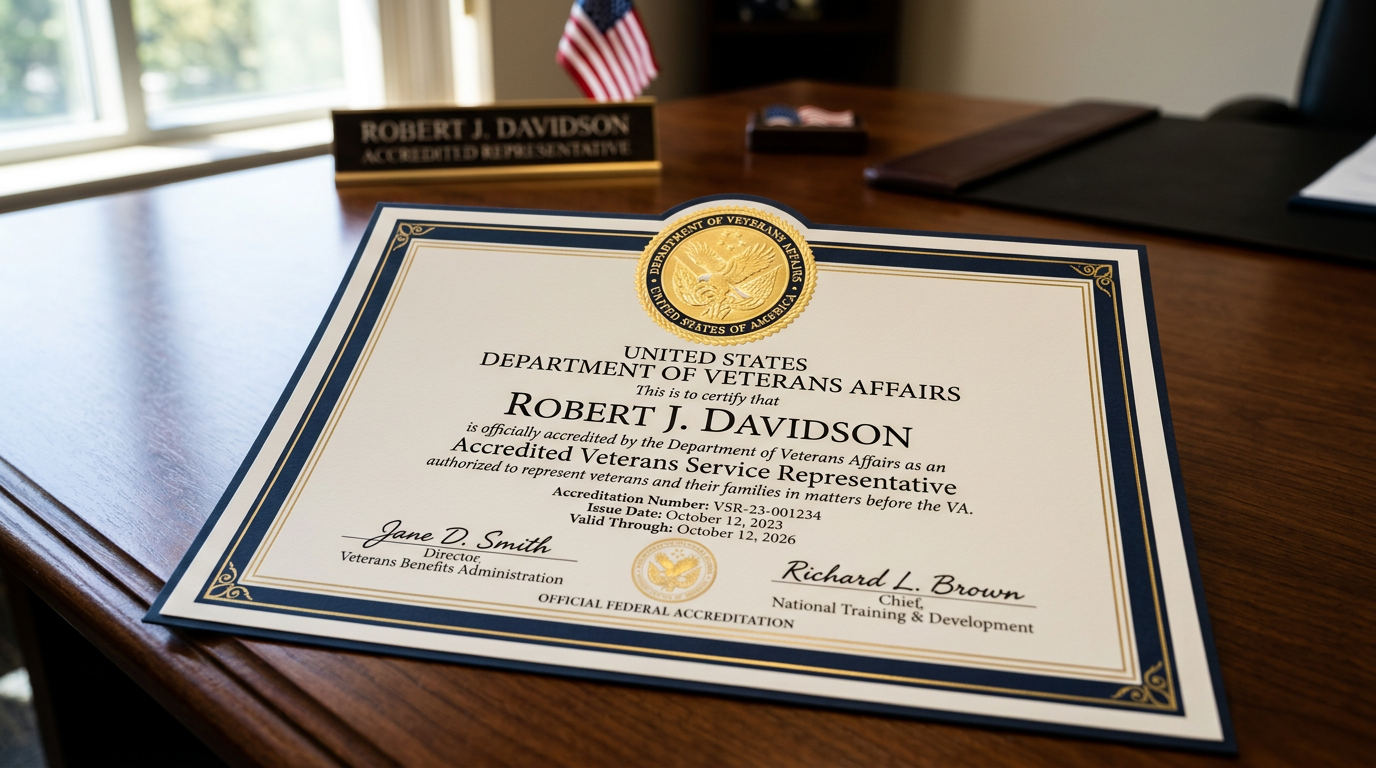
Denied, under-rated, or just stuck? Who represents you is the difference between another denial and the rating you actually earned. Here is the part nobody explains: only a VA-accredited agent or attorney can legally go into your claims file and work it under 38 CFR §14.629. A social-media "claim coach" cannot touch it. That is what accreditation means in practice, and it is why my number, #45147, is public.
What accreditation means
A VA-accredited claims agent is federally authorized under 38 CFR §14.629 to represent you and go directly into your VA claims file. An unaccredited "claim coach" legally cannot touch it.

No win, no fee
Your first records review is free. Fees are contingent under 38 CFR §14.636. You pay nothing up front, and nothing at all unless we actually recover benefits for you.

Verify #45147
Albert L. Thombs Jr. is Accredited Claims Agent #45147. Look it up yourself on the VA Office of General Counsel accreditation search. That number is public for a reason.
What veterans say about working with us
Real reviews from veterans and families we’ve helped — every one read and approved before it appears here.
Design preview. These are placeholder cards showing the layout. Your real, approved veteran reviews will appear here automatically once the review feed is connected.
“This is where an approved review from a veteran you helped will appear — in their words, exactly as you cleared it.”
Sample Review
U.S. Army veteran
“Each card shows the star rating, the quote, and a first-name / last-initial byline. You decide which reviews appear here.”
Sample Review
U.S. Air Force veteran
“Only reviews you approve in VADIS — and that you allow on this site — are ever shown. A past-due client cannot post here.”
Sample Review
U.S. Marine Corps veteran
Stop leaving money on the table
Too many veterans are rated too low or never claim what they earned. Combat-Related Special Compensation, thebilateral factor, dependent allowances, toxic exposure, TDIU. These are the exact places I watch the VA leave money behind. Let an accredited claims agent review your situation and tell you what was missed. The first evaluation isfree, with no obligation.
VA benefits questions, answered
Straight answers to the questions veterans ask me most — with the real numbers and the regulations behind them. Every figure is an estimate based on current VA rate tables, and I will always tell you when only a records review can confirm your number.
How much does a 100% VA disability rating pay per month?
For 2026, a single veteran with a 100% VA disability rating receives approximately $3,938.58 per month in tax-free compensation. That figure rises with dependents -- a veteran with a spouse and one child receives approximately $4,318.99 per month. These are estimates based on current VA rate tables. Your exact payment depends on your specific rating, dependent status, and any Special Monthly Compensation you may qualify for. An accredited review of your records is the only way to confirm your actual entitlement. The VA Disability Advocate, LLC (Accreditation #45147) offers a free initial records review.
What is the VA combined ratings formula and why does it matter?
The VA does not add disability ratings together like regular math. Instead, it uses a 'whole person' method. For example, if you have a 50% rating, the VA treats you as 50% disabled and 50% whole. A second 30% rating is applied to the remaining 50%, adding 15 more points, bringing you to 65% combined, not 80%. This method almost always results in a combined rating lower than the simple sum of your individual ratings. The VA then rounds to the nearest 10% to assign your final rating. This is why many veterans are rated lower than they expect, and why understanding the formula matters before you file or appeal. The bilateral factor under 38 CFR Part 4 can add a small additional percentage when you have ratable disabilities in both arms or both legs.
What VA benefits does the PACT Act add for veterans?
The PACT Act, signed into law on August 10, 2022, as Public Law 117-168, is the largest expansion of VA benefits in decades. It adds more than 20 burn pit and toxic exposure-related conditions to the VA's list of presumptive service connections, meaning veterans no longer have to prove a direct link between their service and those conditions -- the VA presumes the connection. Key groups covered include Post-9/11 veterans exposed to burn pits or airborne hazards in Southwest Asia, Gulf War veterans, Vietnam veterans exposed to Agent Orange in new locations, and veterans exposed to radiation. The law also extended the Agent Orange presumption to veterans who served in Thailand, Laos, Cambodia, Guam, American Samoa, and Johnston Atoll. If you served in any of these locations or time periods, you may already qualify for benefits without a medical nexus letter. Use the free PACT Act Screener on this site to check, then confirm eligibility with an accredited claims agent.
What is TDIU and how do I know if I qualify?
TDIU stands for Total Disability based on Individual Unemployability. It allows a veteran to be compensated at the 100% disability rate even if their combined VA rating is below 100%, as long as their service-connected conditions prevent them from holding substantially gainful employment. Under 38 CFR Section 4.16, there are two paths to qualify. The first is the schedular path: one condition rated at 60% or more, or two or more conditions with a combined rating of 70% or more where at least one is rated 40% or more. The second is the extraschedular path, which requires a referral to the VA's Director of Compensation but has no minimum rating floor. TDIU pay for 2026 is the same as the 100% rate -- approximately $3,938.58 per month for a single veteran, which is an estimate and depends on your full record. If you have been denied TDIU or believe you qualify, an accredited review of your claims file can identify whether the VA applied the regulation correctly.
What is VA back pay and how far back can it go?
VA back pay, formally called retroactive compensation, is the lump sum the VA owes you from your effective date to the date your rating decision was issued. Your effective date is typically the date the VA received your claim, or the date you filed an Intent to File (ITF), whichever is earlier. Under 38 CFR Section 3.400, filing an ITF locks in your effective date for up to one year while you gather evidence and build your case, which can add months of retro pay. In some cases -- particularly for conditions that were clearly present at separation -- an effective date can go back to the day after discharge. For veterans appealing a denial, the effective date on a successful appeal can reach back to the original claim date, potentially years earlier. The back pay estimate tool on this site can show you a rough figure based on your rating and effective date, but exact retro amounts require an accredited review of your official claims file.
Can military retirees receive both VA disability pay and military retirement pay at the same time?
Yes, but there are rules. By default, military retirees must waive a dollar of retirement pay for every dollar of VA disability pay they receive -- this is called the VA offset. Two programs eliminate or reduce that offset. CRDP, Concurrent Retirement and Disability Pay, phases in full concurrent receipt for retirees with a combined VA rating of 50% or higher. CRSC, Combat-Related Special Compensation, restores retirement pay specifically for combat-related disabilities and is available to retirees with any rating, including those below 50%, as long as the disability is combat-related. CRDP is taxable; CRSC is tax-free. You cannot receive both at the same time -- you elect the one that pays you more. The CRDP and CRSC calculator on this site can show you an estimated comparison, but the right choice depends on your full retirement and disability record. An accredited review is the accurate way to confirm which program benefits you more.
Are VA benefits calculators accurate, and do I need an accredited agent to apply?
VA benefits calculators, including the tools on this site, are educational estimators built on current VA rate tables. They are designed to give you a realistic ballpark figure so you can plan and apply with confidence. They are not a substitute for an official VA determination, and no calculator can account for every variable in your personal claims file -- your specific ratings history, dependent changes, effective dates, and any Special Monthly Compensation you may qualify for. You do not need an accredited agent to apply for VA benefits for the first time. However, if you have been denied, received a lower rating than you expected, or believe you qualify for benefits the VA has not granted, working with a VA-accredited claims agent can make a significant difference. Albert L. Thombs Jr., Accreditation #45147, is a federally authorized agent who can go directly into your VA claims file to find the errors and medical gaps that caused your denial. The initial records review is free, and fees are only charged if he wins your case, in accordance with 38 CFR Section 14.636.
How does the VA rate PTSD and other mental health conditions?
The VA rates PTSD, depression, anxiety, and most other mental health conditions under one General Rating Formula for Mental Disorders in 38 CFR Section 4.130. The possible ratings are 0, 10, 30, 50, 70, and 100 percent, and the level depends on how much your symptoms interfere with work and daily life -- not simply on your diagnosis. For example, a 70 percent rating reflects deficiencies in most areas such as work, family relationships, judgment, and mood, while a 100 percent rating reflects total occupational and social impairment. A common and costly VA error is rating a veteran at 50 percent when the documented symptoms clearly support 70 percent, which is also the threshold that can open the door to TDIU. Because mental health ratings are so dependent on how the evidence is written, an accredited review of your C&P exam and treatment records often finds room for a higher, more accurate rating.
What is Special Monthly Compensation (SMC) and who qualifies?
Special Monthly Compensation, or SMC, is additional tax-free pay above the standard disability rates for veterans with especially serious disabilities or losses. It is authorized under 38 U.S.C. Section 1114 and 38 CFR Section 3.350. SMC is paid on top of your regular compensation for situations such as loss or loss of use of a hand, foot, or reproductive organ, blindness or deafness, or the need for the regular aid and attendance of another person. The most commonly missed level is SMC-K, a special allowance for loss of use of a specific body part, which is added to your monthly check. Many veterans who qualify for SMC are never told about it, so it is one of the first things an accredited agent checks when reviewing a claims file. The exact SMC amount depends on the level awarded and is set by the current VA rate tables.
Can I receive VA disability and Social Security Disability (SSDI) at the same time?
Yes. VA disability compensation and Social Security Disability Insurance (SSDI) are two entirely separate programs, and receiving one does not reduce the other. VA disability is based on service-connected conditions and is not means-tested, while SSDI is based on your work history and whether your conditions prevent substantial gainful employment. You can receive both at full value at the same time. Importantly, a 100 percent VA rating or a TDIU award does not automatically qualify you for SSDI, and SSDI approval does not automatically grant a VA rating -- each agency applies its own rules. That said, a favorable decision from one program can serve as supporting evidence in the other. If your service-connected conditions keep you from working, it is worth pursuing both, and an accredited review can help make sure your VA record is as strong as possible.
What is VA pension with Aid & Attendance, and how much does it pay in 2026?
VA pension is a needs-based benefit for wartime veterans with limited income who are age 65 or older or permanently and totally disabled for reasons not necessarily related to service. It is different from disability compensation. For 2026, the maximum annual pension for a single veteran is approximately $17,441 per year, and with the Aid & Attendance enhancement -- for veterans who need help with daily activities such as bathing, dressing, or eating, or who are housebound -- the maximum rises to approximately $29,093 per year for a single veteran. These figures are set under the Maximum Annual Pension Rate tables referenced in 38 CFR Section 3.23 and are estimates that depend on your countable income and medical expenses. The Pension and Aid & Attendance calculator on this site can give you a rough figure, and an accredited review can confirm eligibility and help document the medical need.
What is DIC and how much does a surviving spouse receive in 2026?
Dependency and Indemnity Compensation, or DIC, is a tax-free monthly benefit paid to eligible surviving spouses, children, and parents of service members who died in the line of duty or veterans whose death resulted from a service-connected condition. It is governed by 38 CFR Section 3.5 and related regulations. For 2026, the base DIC rate for a surviving spouse is approximately $1,699.36 per month, with additional amounts available for dependent children, for spouses who need aid and attendance, and in certain cases where the veteran was rated totally disabled for at least eight years before death. Survivors are frequently unaware they qualify, especially when a veteran passes years after service from a condition that was never formally service-connected. An accredited review can determine whether a claim for DIC or accrued benefits is available to the family.

Two ways to get started. Both free.
Have a question about your rating, your eligibility, or what to do next? Ask me. It costs nothing and there is no form to fill out. Or, when you are ready to have us fight your claim, register and an accredited agent starts reviewing your file. My rule is simple: we only want what you earned, nothing more.
Your consultation is free, no obligation. Registering does not make you a client until we have reviewed your case and you tell us to move forward.