Medical evidence
Disability Benefits Questionnaires (DBQs), explained
A DBQ is a standardized VA form your own provider fills out to document a condition. Used well it can speed up a claim — here is how they work, their limits, and how to pair one with a nexus letter.
What a DBQ is, how to use one, why the VA may still order a C&P exam, and how to pair a DBQ with a nexus letter.
Start here
What a DBQ is
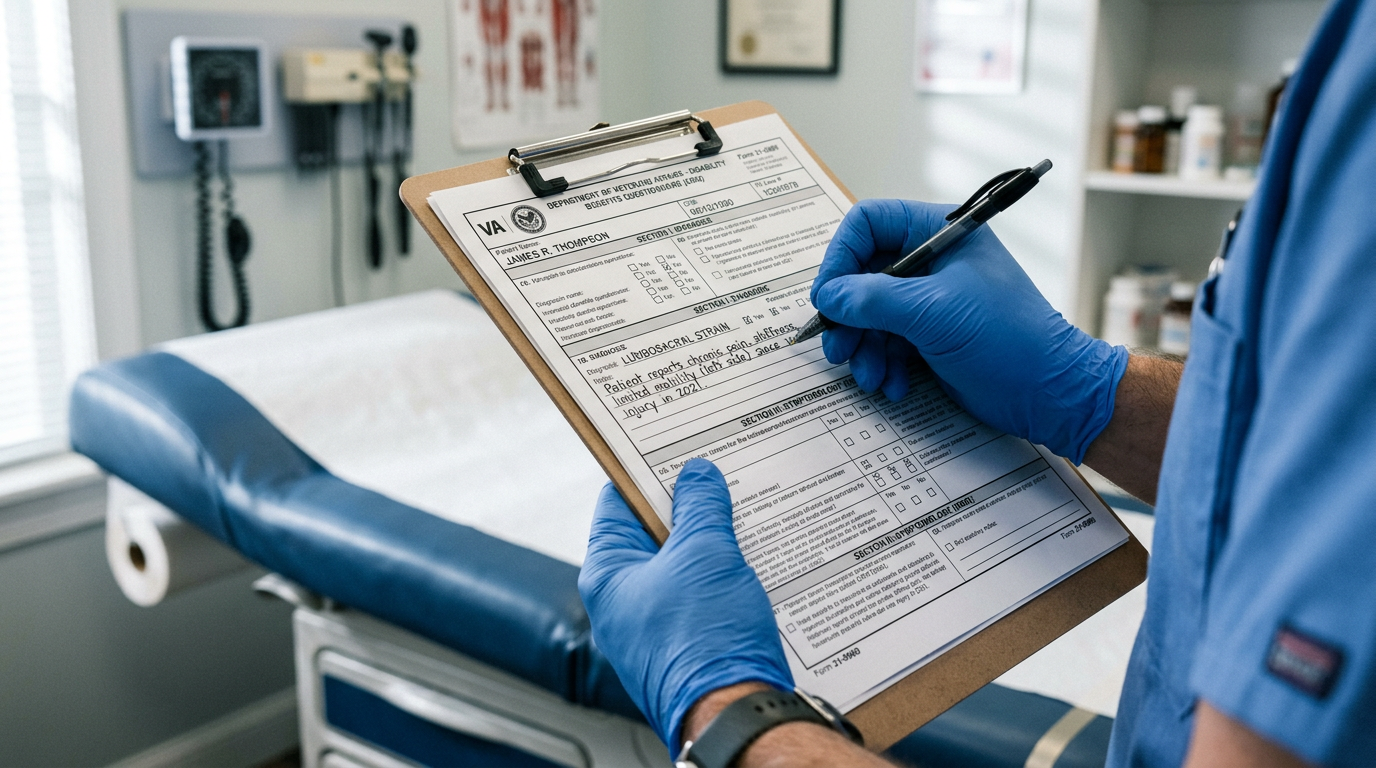
A Disability Benefits Questionnaire (DBQ) is a form the VA developed to streamline how medical information is collected for a claim. Each DBQ is tailored to a specific condition, giving your healthcare provider a standardized way to document your diagnosis, medical history, and the severity and impact of your symptoms.
- 1
Download the right form
Choose the DBQ that matches your condition and download it. You can also review it beforehand to understand the questions your exam will cover.
- 2
Take it to your provider
Bring it to a qualified healthcare provider with the proper certification, who completes the diagnosis, history, and symptom sections.
- 3
Submit it with your claim
Submit the completed DBQ to the VA as part of your disability claim, alongside your other evidence.
The VA does not reimburse the cost
If a private provider completes your DBQ, the VA does not reimburse the cost. And be cautious interpreting a DBQ on your own — some sections contain medical terminology that is hard to read without training.
A common surprise
Why the VA may still schedule an exam
Even when you submit a DBQ from your private provider, the VA may still require its own examination. This is not a rejection of your evidence — it is the VA making sure the most accurate, complete information is on file.
There are a few reasons. First, the VA verifies the consistency and completeness of the information; a DBQ is a snapshot and may not capture every aspect needed. Second, C&P exams are conducted by VA-trained professionals following standardized protocols, which keeps evaluations uniform and fair across all claims. Third, conducting its own exam lets the VA confirm the findings and gather any additional information needed to decide the claim.
The winning combination
Pairing a DBQ with a nexus letter
DBQ + nexus letter
A DBQ documents your current medical condition; a nexus letter connects that condition to your service with the phrase "at least as likely as not." Together they create a compelling case — comprehensive medical evidence plus a professional opinion — that can be decisive in the VA’s decision.
Be realistic, though: the VA is the deciding factor and the process is not always straightforward. Even with a strong DBQ and nexus letter, the VA may require additional exams or interpret the evidence differently, which can lead to denials or lower-than-expected ratings. These documents substantially enhance a claim — they do not guarantee approval. An Accredited VA Disability Advocate can help make sure your evidence is presented accurately and considered fully.
The full menu
DBQ condition categories
DBQs exist for conditions across nearly every body system. An accredited advocate can help you identify the right one and explain any confusing sections. The main categories include:
Psychological
PTSD, Mental Disorders, Eating Disorders.
Musculoskeletal
Spine (neck & back), knee, shoulder, hip, hand, foot, ankle, elbow, wrist, amputations, muscle injuries.
ENT
Ear (including vestibular), loss of smell/taste, sinusitis, rhinitis, and throat conditions.
Cardiovascular
Heart conditions, hypertension, artery and vein conditions.
Respiratory & Sleep
Respiratory conditions and sleep apnea.
Neurological
Headaches/migraines, peripheral nerves, seizures, MS, Parkinson’s, fibromyalgia, ALS, TBI.
Additional DBQ categories cover gastrointestinal, genitourinary, endocrine (including diabetes and thyroid), dermatological (scars and skin diseases), rheumatological (arthritis, lupus, chronic fatigue), gynecological, dental & oral, and infectious diseases — among others.
Reading up is smart. Having us in your corner is smarter.
You don’t have to navigate this alone. Ask us anything about your situation for free, or register when you’re ready to have an accredited agent handle your claim.
I read every one of these myself. If you qualify, you’ll hear from me within 48 hours. Or call 702-992-4883.
Want a second set of eyes on your claim?
Albert Thombs is an accredited VA claims agent (#45147). A free review will tell you what evidence your claim is missing and how to strengthen it — before you file.
Call 702-992-4883 · Mon–Fri, 11:00 – 18:00 Pacific