

2026 Burial Allowance Estimator
The VA pays a tax-free allowance toward a veteran's burial, funeral, and interment costs. See what you qualify for, whether the death was service-connected or not, and learn every benefit the family is owed.
For deaths on or after Oct 1, 2025
Honor them without draining the family’s savings
When a veteran passes, the VA helps carry the cost of laying them to rest — a tax-free burial allowance, a free gravesite in a national cemetery, a headstone, a burial flag, and military honors. Most families never claim it all because no one tells them it exists. Use this tool to see what your family has coming — and exactly how to claim it.
Up to $2,000
Service-connected death
Up to $2,004
Burial + plot allowance
Free to the family
National cemetery gravesite

First, the one question that changes everything
The VA pays a different amount depending on why the veteran died — and almost no grieving family has heard the term “service-connected” before. Here is what it means in plain English, and how to tell which one fits your veteran.

Service-connected death
The veteran died because of their military service. The condition that caused death was already rated by the VA, or was caused or made worse by service — think a service-connected cancer or heart condition, the lasting effects of a combat injury, or a toxic-exposure illness.
The VA pays
Up to $2,000 · no deadline, ever

Not service-connected
The veteran died from something the VA has not tied to service — an unrelated illness, an accident, or old age — but was still a veteran who was receiving (or entitled to) VA pension or compensation, or who died in a VA facility.
The VA pays
Up to $2,004 · file within 2 years
$1,002 burial allowance + $1,002 plot allowance
Not sure which one applies? You don’t have to guess. Whether a death counts as service-connected can turn on the veteran’s medical records and rating history — and a service-connected finding can also unlock DIC, a monthly, tax-free payment to survivors usually worth far more than the burial allowance itself. If the death may trace back to toxic exposure, take the 60-second check further down this page — that’s the one piece we can help you sort out.
Estimate the burial allowance
Service-connected means the VA has tied the cause of death to a condition from military service.
This removes the 2-year filing deadline and can add transportation reimbursement.
Includes dying in a VA hospital, a VA-contracted nursing home, or while traveling at VA expense for care.
What’s included in your estimate
Answer “What caused the death?” above and your itemized allowance will be listed here, line by line.
Answer one question to see your estimate
Choose whether the death was service-connected on the left, and this box will show your family’s estimated one-time allowance.
The biggest benefit isn’t cash: burial in a VA national cemetery — the gravesite, opening and closing, a headstone, and perpetual care — is free to the family.
The VA and National Cemetery Administration pay these directly — we’ll point you to them. Think the death was service-connected? Take the 60-second check below.
Official VA burial allowancesDeath benefits vs. survivor benefits — and how they connect
Families hear these two terms as if they mean the same thing. They don’t — and knowing the difference tells you exactly who to call and what to ask for.
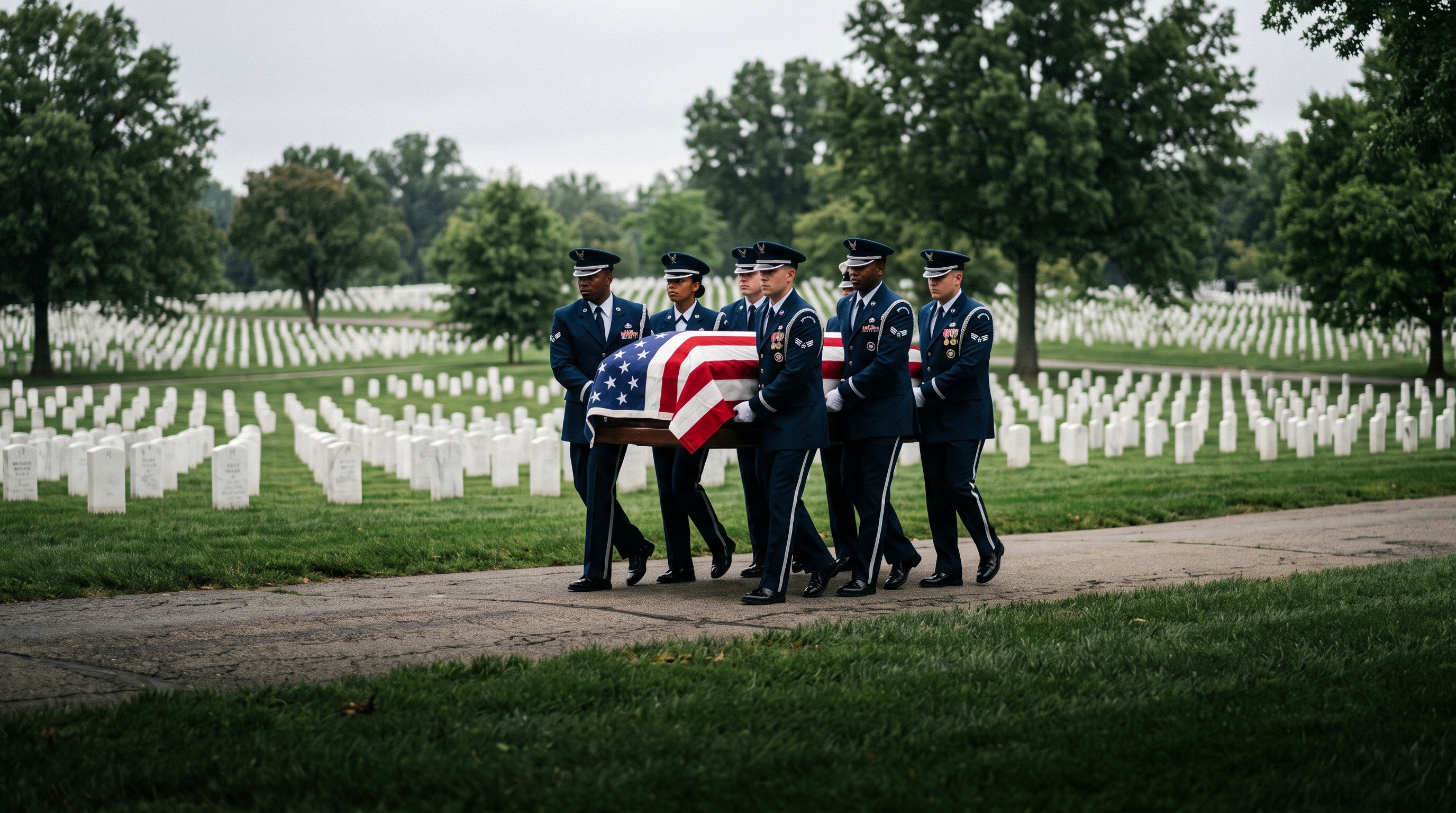
Death (burial) benefits
One-time · paid at the time of death
The burial and plot allowance, a free national-cemetery gravesite, a headstone or marker, the burial flag, and military funeral honors. These help pay for and carry out the funeral and burial — and they’re everything above on this page.

Survivor benefits
Ongoing · month after month
DIC (Dependency & Indemnity Compensation) and Survivors Pension — monthly, tax-free payments to an eligible spouse, child, or dependent parent, plus health coverage and education for dependents.
The thread that ties them together: both flow from the veteran’s service — and if the cause of death was service-connected, it can raise the benefits on both sides, including monthly DIC that is usually worth far more than the burial allowance. That one question — was the death service-connected? — is the piece worth getting right, and it’s the only part of this we handle. Everything else runs through the VA and the National Cemetery Administration — and we’ll show you exactly how to reach them below.
What the VA covers beyond the check
The allowance is only part of it. Every eligible veteran has earned a full set of memorial benefits — most of them free, and most of them missed simply because families don’t know to ask. Tap any benefit below to read exactly what it is, who qualifies, and how to get it — all right here, no hunting through government websites.

The honors they earned, guaranteed by law
Every eligible veteran is entitled to military funeral honors — the folding and presentation of the flag, and the sounding of Taps. It costs the family nothing, and no veteran should be laid to rest without it. Your funeral director can request honors directly, and we can make sure nothing gets left off the list.
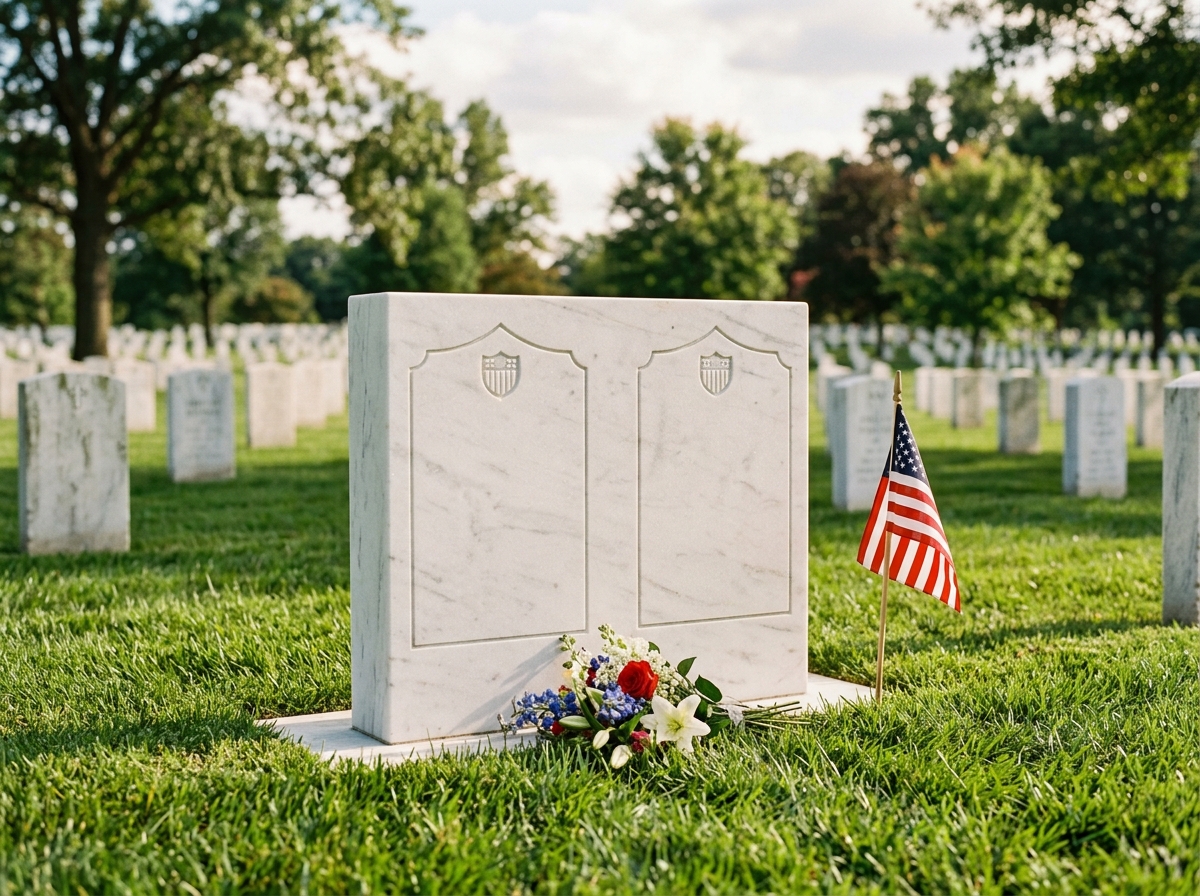
Yes — a veteran and spouse can rest together
It’s one of the most common questions families ask — and the answer decides which kind of plot to choose. In a VA national cemetery, an eligible spouse and dependent children can be buried in the same gravesite as the veteran, at no cost. Knowing this ahead of time lets you plan the right plot now, instead of leaving the decision to the hardest day.
One gravesite, the whole family
National cemeteries use gravesite sharing: the veteran, an eligible spouse, and dependent children can share a single plot. The spouse’s name is inscribed on the back of the veteran’s headstone at no charge.
The spouse can go first
If the spouse passes before the veteran, they can be buried in the gravesite now, and the veteran laid to rest in the same spot later. Eligibility doesn’t depend on who dies first.
Remarriage doesn't end eligibility
A surviving spouse who later remarries generally keeps the right to be buried with the veteran — a rule in place since 2000. Same-sex spouses and legal-union partners are included.
Casket or cremation changes the plot
In-ground casket gravesites and columbarium niches for cremated remains are assigned by type at the time of need. Deciding casket vs. cremation early helps the cemetery match the right space for the family.
Choosing a private cemetery? If the family wants to be buried together outside a national cemetery, you’ll need to buy the plots yourselves — the VA pays the veteran’s plot allowance (up to $1,002) and provides a free marker, but doesn’t cover a spouse’s space. Either way, filing pre-need eligibility (VA Form 40-10007) now confirms who qualifies and spares your family the paperwork later.
The 2026 allowances, in black and white
These are the current maximum, tax-free amounts. They are reimbursements — the VA repays costs that were actually paid, up to these caps.
Service-connected death
When the cause of death is tied to service
$2,000
Non-service-connected burial & funeral
When the veteran was receiving or entitled to VA pension or compensation
$1,002
Plot / interment allowance
Only when the veteran is not buried in a national cemetery
$1,002
Private headstone / marker reimbursement
When the family buys a private marker instead of a free government one
$441
For deaths on or after Oct 1, 2025. Amounts are adjusted each Oct. 1.
Who gets paid — and in what order
The VA pays the first eligible person to file, working down this list. Whoever actually paid the funeral bill usually has the strongest claim.
- 1The surviving spouse
- 2The surviving partner of a legal union with the veteran
- 3The veteran’s children, at any age
- 4The veteran’s parents or surviving parent
- 5The executor or administrator of the veteran’s estate
- 6The funeral home, if the remains go unclaimed
Surviving spouses often don’t file at all. If you’re already on the veteran’s VA record, the burial allowance is usually paid to you automatically once the VA is notified of the death.
The clock is different for every claim
Missing a deadline is the most common way families lose money they were owed. Only one of these actually runs out.
Non-service-connected burial allowance
File within 2 years of the veteran's permanent burial or cremation.
Service-connected burial allowance
No time limit. You can file whenever you're ready.
Plot / interment & VA-hospitalization allowance
No time limit to claim.
Transportation of the remains
No time limit when the veteran qualifies.
National cemetery or private? Weigh it honestly
There’s no wrong answer — but the money works very differently. A national cemetery covers far more for free; a private cemetery gives the family a choice of location and pays a plot allowance back.
VA national cemetery
Private cemetery
Four myths that cost families money
The VA pays the funeral home directly.
It's a reimbursement. Someone pays the bill first, then the VA repays the eligible survivor — so keep the itemized, paid receipt.
You must use a national cemetery to get anything.
No. A private-cemetery burial still gets the burial allowance, the plot allowance, and a free government headstone or marker.
Bad-paper discharge means don't bother.
Only a dishonorable discharge fully bars benefits — and a discharge upgrade can restore them. Many 'less than honorable' cases still qualify.
Spouses can't be buried with the veteran.
Eligible spouses and dependent children can be buried in a national cemetery at no cost — even if they pass before the veteran does.
How you actually claim it
Four steps, in order. Every form below opens the official page on VA.gov — never a third-party copy.
- 1
Schedule the burial
National Cemetery Scheduling Office · 800-535-1117For a national cemetery burial, the funeral director or family calls the scheduling office. Have the veteran’s DD214 ready to confirm eligibility fast.
- 2
Claim the burial allowance
VA Form 21P-530EZThe one form that pays the money. Attach the death certificate and the itemized, paid funeral bill. This is the step families forget — and it’s where the dollars are.
- 3
Order the headstone or marker
VA Form 40-1330Requests a free government headstone, marker, or medallion — even for a private-cemetery burial.
- 4
Request the burial flag
VA Form 27-2008Gets the United States flag to drape the casket or accompany the urn, then kept by the next of kin. Any post office or VA office can issue it.
Have these in hand before you file
A claim with all of this attached is a fully developed claim — it pays fastest. Pull these together once and the whole thing goes smoothly.
One warning that saves real money: the VA reimburses what was actually paid, so don’t throw away a single receipt. Keep everything for at least three years in case the VA asks for proof.
Talk to the people who do this every day
For the burial allowance, a national-cemetery gravesite, and survivor benefits like DIC and Survivors Pension, the VA and the National Cemetery Administration are your team — and they are very good at it. We don’t file these for you. Here is the direct line so you never get lost in a phone tree.
National Cemetery Scheduling Office
Best for: Burial in a VA national cemetery
- Schedules the burial and confirms eligibility on the spot
- Handles the gravesite, opening and closing, and perpetual care
- The single best resource for a national-cemetery burial — it is all they do
VA Benefits Hotline
Best for: Burial allowance & survivor benefits
- The burial and plot allowance (VA Form 21P-530EZ)
- DIC and Survivors Pension for the family (VA Form 21P-534EZ)
- Status of an existing claim or the veteran’s VA file
How to actually apply — the official pages:
Was the death caused by toxic exposure?
If a veteran was exposed to Agent Orange, burn pits, contaminated water at Camp Lejeune, or ionizing radiation — and later died from an illness tied to it — the family may be owed a service-connected claim and monthly, tax-free DIC. This 60-second check is just a starting point, not a decision.
Where and when did the veteran serve?
Pick the exposure that fits their service. Not sure? That is fine — there is an option for that too.
Rather just talk it through with a person?
About this benefit
The VA burial allowance is a tax-free payment that helps cover a veteran's burial, funeral, and transportation costs. It is usually paid to the person who covered those expenses.
The amount depends on whether the death was service-connected and where the veteran is buried. Veterans are also eligible for a free gravesite in a VA national cemetery, a headstone or marker, and a burial flag.
How to use it
- 1Select whether the death was service-connected.
- 2Indicate where the veteran is buried and whether the family bought a private headstone.
- 3Note whether the veteran died while in VA care — it changes the deadline and transportation.
- 4Review the allowance, then use the linked forms to claim it and order the headstone and flag.
What it covers
- Service-connected & non-service-connected burial allowances
- Plot / interment and private headstone reimbursement
- The full memorial package: gravesite, headstone, flag, honors
- Who gets paid, filing deadlines, and every official form
Official VA links
Work with our accredited agent and disability advocates
Ready to turn this estimate into a claim? Let a specialist handle it.
Calculators are a starting point. Both options below are free. Have questions? Get a free case evaluation — no paperwork, nothing to sign. Ready to hire us? Register with us: it’s free to register, and involves signing VA Form 21-22a so we can act on your claim.
This calculator provides an estimate only based on published VA rate tables. VA Benefits Calculators is not affiliated with the VA — the VA makes all final decisions about eligibility and payment amounts. Always confirm details at va.gov.